Place guide
Regional Museum of Travnik: explore the region’s collections
On this page
Choose the Regional Museum of Travnik for a broad introduction to the area’s material culture, natural history, everyday life and customs. Its displays range across several departments; look for the natural-history and outdoor collections as well as local cultural objects. It complements the nearby Ivo Andrić memorial house, which has a more focused literary subject. Allow about 45–75 minutes.
How the collection is organised
The museum’s permanent exhibition has four strands: cultural and historical collections, natural history, life and customs in the Travnik region, and an open-space exhibition. The museum describes the cultural-historical display as incomplete, but says it follows the region’s story from prehistory to the end of the nineteenth century. Its own overview highlights prehistoric stone and quartz tools, Bronze and Iron Age material and a Greek-Illyrian-style bronze helmet; the Roman displays include coins, ceramics and architectural fragments. These are examples from the museum’s collection guide; not every item is always on view.
The natural-history rooms may deserve extra time if fossils, minerals or zoology interest you. Its published overview distinguishes the much larger holdings from the selected permanent display. It groups the exhibition into palaeontology, mineralogy and petrography, and zoology, with a section on founder Erik Brandis and his natural-history work. Outdoors, the museum describes a small garden with local plants, particularly from Vlašić, and an open lapidary containing a sarcophagus from Stara Bila and two medieval stones moved from Mašeta in 2012. Ask whether the grounds are accessible during your visit. For a shorter visit, choose cultural history or natural history as your main strand. Allow longer than an hour to read across both; the outdoor garden and lapidary depend on weather and access.
Getting there and what to expect
The museum is at Mehmed-paše Kukavice 1, beside Bosanska Street. The museum uses Travnik’s old Ćiro locomotive as a landmark; public parking and a taxi stand are in front. From the intercity bus station on Stanična, orient towards Bosanska and Travnički korzo, then continue through the centre. The entrance has steps, so contact the museum ahead of time if you need specific assistance. The building should not be assumed to have step-free access.
The museum’s published visitor information, checked 15 November 2026, lists hours of 09:00–15:00 on weekdays and 10:00–14:00 at weekends. Adult admission is 5 KM; pupils, students and pensioners pay 4 KM. The public page gives no holiday guarantee, so confirm around public holidays. For a group visit, specialist guidance or an access question, contact the museum at +387 61 821 746 or muzej.travnik@bih.net.ba.
Combine the museum with the old town
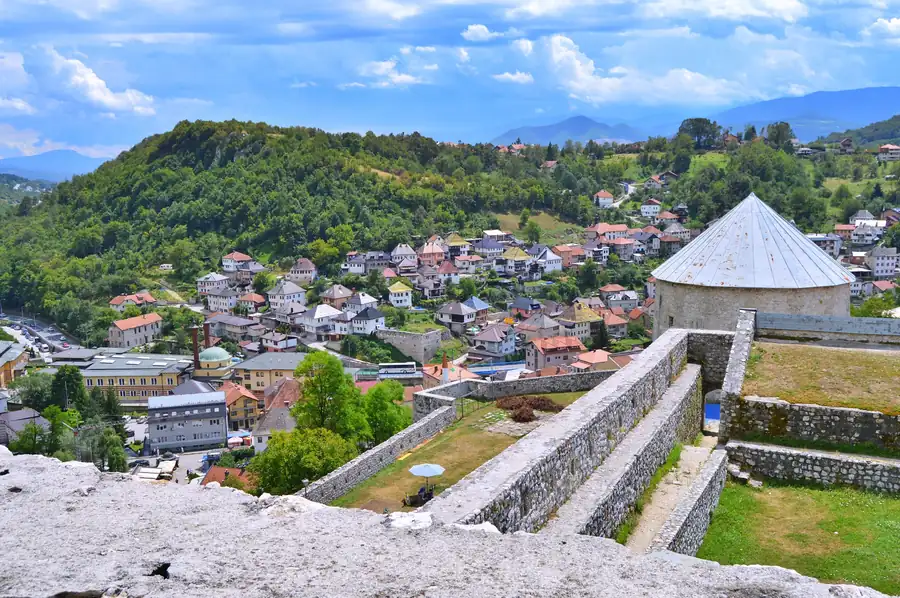
The Ivo Andrić memorial house is about 100 metres away on Zenjak, making the two collections easy to pair if you want both a regional overview and a literary focus. That exhibition also involves stairs, so check both venues if access is a concern. On a weekend, visit the Regional Museum before lunch because it closes at 14:00. The medieval fortress is a separate uphill stop; keep it for another part of the day rather than rushing the museum. For a local meal, Travnik’s tourism board highlights ćevapi with pitica, Vlašić cheese and Lutvina coffee; check menus and dietary options with the venue.