Place guide
Maglaj Fortress: a stronghold above the Bosna
On this page
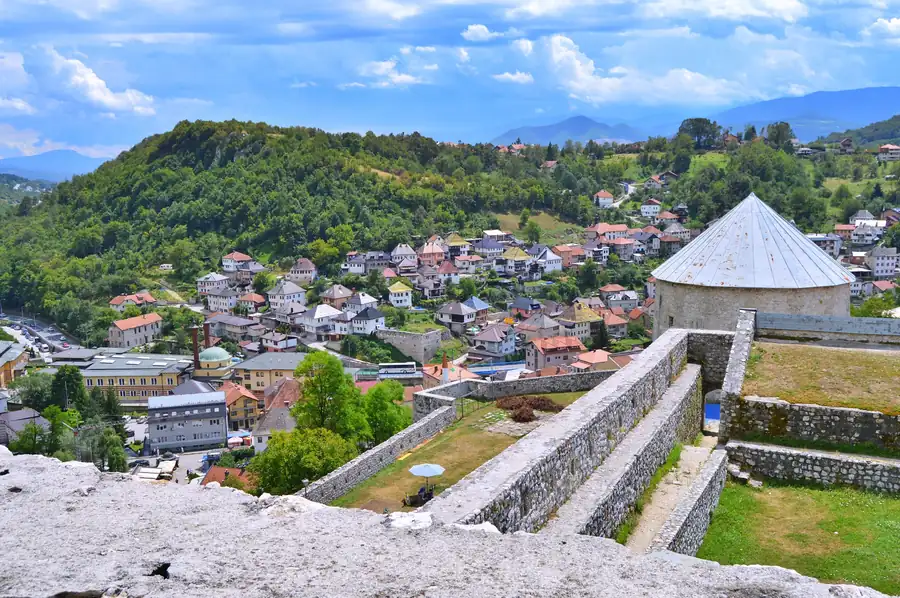
Maglaj’s fortress makes most sense when you look at the river below it. The stronghold occupies steep rock above the Bosna’s right bank, overlooking a valley that carried movement through the region. The local heritage project’s account describes its original role guarding that corridor and its later growth as the settlement around it developed.
This is an outdoor fortress visit, not a furnished castle. The interest lies in its position, walls and changing defensive form. Give the old quarter below it some time too: the climb and the town belong to the same story.
A medieval core, altered for later warfare
The fortress appears in a charter of King Sigismund in 1408. Its visible form is not simply the structure from that date preserved unchanged. Ottoman building phases reshaped the site, including adaptations to increasingly powerful artillery. The heritage account distinguishes a surviving medieval core from those later changes.
That is a useful way to read the place without needing to identify the date of every stone. Look at how the masonry follows the rock, where the towers command an approach and how the enclosed spaces relate to the town below. It was a working military installation repeatedly altered to stay useful, not a single architectural composition.
The clocktower adds another layer. The municipality’s heritage overview places it in the forecourt of the old town. It belongs to the history of public timekeeping, distinct from the fortress’s military purpose. Ask about entry and whether the mechanism operates before making either the purpose of the visit.
Before making the climb
Current entrance arrangements need checking with Maglaj municipality or a responsible local visitor contact. The published heritage descriptions explain the monument but do not supply a dependable daily opening timetable, ticket price or accessible route. Ask whether the visitor entrance and intended areas are open on your date, particularly if work is taking place.
The approach is uphill and the historic surfaces deserve proper footwear. Visit in daylight; stay on open visitor routes and behind any barriers. Do not use a map’s short distance as a measure of how easy the ascent will be. If steps or uneven ground are a barrier, confirm the actual approach before committing to the climb.
Once access is confirmed, allow roughly 45–60 minutes at the fortress, with additional time for getting up and back. A visit to the old quarter can take the rest of a relaxed morning or afternoon. Keep food and facilities in the town plan rather than assuming they are provided inside the monument.
Continue through the old quarter
Kuršumlija, also called Jusuf-paša Mosque, offers a contrast in purpose and form. The municipality dates it to the second half of the sixteenth century, while acknowledging differing dates within that period. View it as a place of worship: an exterior stop does not imply permission to enter.
Uzeirbegov konak, beside the Bosna, adds a nineteenth-century domestic building to the picture. The municipal account dates it to around 1875 and associates it with Salih-beg Uzeirbegović. Even without an interior visit, the contrast is worthwhile: a stronghold on rock, a mosque in the old quarter and a house by the river are three different expressions of the same town.
The payoff is not simply the view from the top. It is seeing how Maglaj’s buildings occupy the valley, then returning to street level with that arrangement in mind.
For where to stay and what else is nearby, see the Central Bosnia region page.
Related Browse the place guides.