Place guide
War Childhood Museum, Sarajevo
On this page
The War Childhood Museum is the most affecting museum in Sarajevo, and one of the most original anywhere. It tells the siege through the things children kept: a diary, a pair of ballet shoes, a tin of food, each with a short account by the person who owned it, now grown up. You’ll spend most of your time reading, so allow an hour. It won the Council of Europe Museum Prize in 2018.
Allow 60–90 minutes as a starting point, and longer if you tend to read every account. Leave a little room afterwards for a quiet break. The museum is at Logavina 32, uphill from the old centre, and is easy to pair with a shorter Baščaršija walk.
Entrance access
Entrance access checked 14 November 2026: the museum still reports its entrance lift out of service. There are two entrance steps. If your visit depends on step-free access, contact visit@warchildhood.org or +38733 535558 before setting out. The entrance restriction applies even though the exhibition itself has accessible facilities.
What to expect inside
The exhibition brings belongings together with their owners’ accounts, using ordinary objects to explore experiences such as shelter, displacement, loss and play. Its starting point is childhood during the Bosnian war, with experiences from other conflicts also represented.
Give each story enough time to stand on its own. You can follow these personal accounts without a detailed knowledge of military history. If that distinction changes your choice, compare it with the Historical Museum and the War Tunnel in the Sarajevo museum chooser.
The selection changes, so do not organise a visit around a single object seen in a photograph. Multilingual QR guides let you explore at your own pace.
Visiting with children
The museum supplies family guides for ages four-plus and eight-plus, identifies material for younger visitors and provides a children’s drawing area. These can help an adult shape the visit, but they do not make every story suitable for every child. Decide together how much to see and feel free to make it a short visit.
Seats and a baby-changing area are available. With a pushchair, use the entrance advice above. A meal or an ordinary walk gives families a break after the visit.
Opening hours and tickets
Ordinary hours are daily 11:00–19:00, with last entry 18:30. The museum closes on 1 January, 1 March, 1 May and 25 November. On 31 December, it opens 11:00–16:00. Temporary changes are posted on the museum’s visitor page.
| Ticket | Price |
|---|---|
| Adult | 15 KM |
| University student | 12 KM |
| Child aged 6–17 | 7 KM |
| Child aged five or under | Free |
| Family of two adults and up to five children aged 6–17 | 35 KM |
Cards are accepted. The museum also offers free entry on the last Thursday of each month, 17:00–19:00, with the usual 18:30 last-entry limit. Arrive early enough to read comfortably; the final admission time leaves only half an hour before closing.
Groups of ten or more should contact the museum in advance. Its website offers online booking, but does not state that every individual visitor must reserve before arriving.
Finding the entrance and planning the rest of the day
Use the full name and Logavina 32 in your map. The museum names Baščaršija and Katedrala as the nearest tram stops, and the Gazi Husrev-beg Mosque and Sacred Heart Cathedral as nearby walking landmarks. Open walking directions from the cathedral. This is an uphill approach, not a verified step-free route.
Parking is limited. If you need mobility assistance, ask the museum about parking and the entrance together.
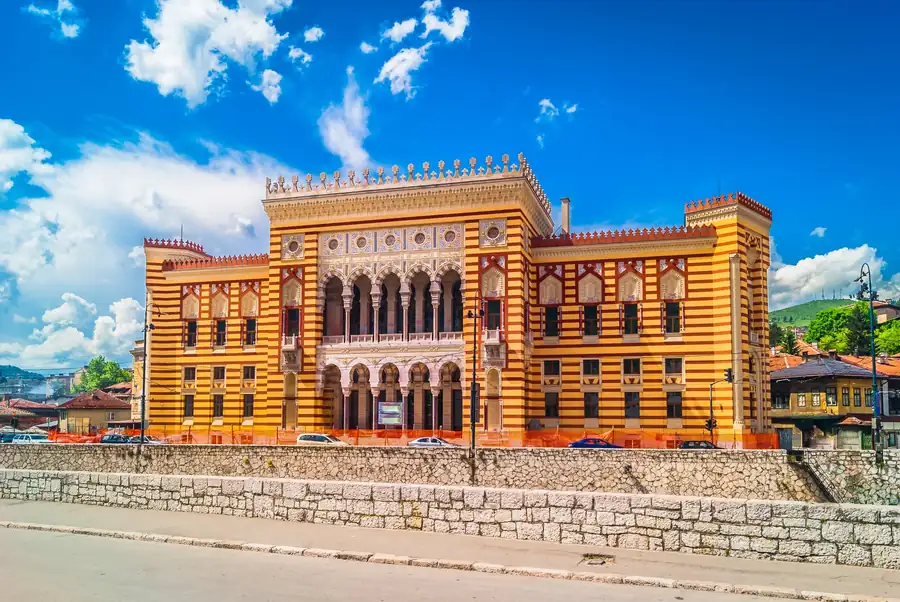
For a first stay, place the visit after an old-town lunch, as in the two-day Sarajevo itinerary. If you decide the subject is not right for your party, Brusa Bezistan offers a shorter city-history visit, while City Hall is an architectural alternative. They have their own opening days.
Visitor information and lift notice checked 14 November 2026.